Saturday, May 21, 2016

Free and Pre-Paid

One of the perks or, I should say, irks (I am probably coining a new noun here) of life today is the unending stream of junk mail we receive. I have mentioned this in one of my previous posts and if you are a regular reader you know where I stand with regards to such mail. I usually throw them in the trash or in a pile to be shredded in case it has name, address and other personal details. This means that I have to at least glance at the envelope before deciding where it goes.

Years ago, Publishers Clearing House used to send out mailers that made it appear that you have won a lottery. It would have the name printed with words like 'pay to' and big numbers with dollar signs attached to them. On closer examination, you found out that it was an invitation to participate in a sweepstakes and not an announcement of winning. I think they have moved online now entirely, but the first time you received such a mail you were bound to be fooled into thinking you had won. Instead of actually winning, you had the opportunity to have a 1-in-10 million chance of winning. What a let down!

Nowadays, the weeding process is swift and I rarely hesitate to see if I should actually open the envelope before tossing it. Occasionally something catches my eye and I open the mail. This does not usually change their fate, but one such envelope recently made me sit up. The fact that it has both 'Free' and Pre-paid' as adjectives to an offer was only part of the reason. The envelope in question was rather plain and beige-coloured, hardly flashy. It was properly addressed but I was not to be fooled that easily. At the left-hand bottom corner, it said, 'Free Pre-Paid Cremation! Details Inside'. How could one resist that?

'Live free or die' said someone. I would advise you to make the most of living free because dying seems to be quite expensive. For those who bury their dead, reserving a plot or a place in a cemetery will be quite important. The availability of plots may be limited in urban areas considering the demand for land. They can be quite expensive too. I am sure advance planning is critical if you have a specific location in mind. At the same time, I have to say that advertisements for plots - "Set on a grassy knoll overlooking a small lake", "Gorgeous trees", "Serene and peaceful with beautiful views" and so on leave me puzzled. I do not see how this is of importance to the departed souls.

The cost associated with burials has given the idea of cremation a boost. And that explains the marketing flyer in my mailbox. A free funeral is certainly valuable in saving money for the family. But how can something be free and pre-paid at the same time? I was intrigued. It is not that one expects logic from such offers. I have seen snack packages that ask you to enter a contest/lottery to win big prizes with the additional phrases 'No purchase necessary' and 'Details inside'. So something like this is par for the course. Still, I wondered how a company would go about trying to get people to buy cremation services. This one succeeded at least in making me open the letter,

The letter talked about why cremation is a better solution than burial - cheaper, less impact on environment, and portable - you can keep the dear departed in an urn on the mantle and take them with you if you move across the country. No need to visit the grave to remember them. And so on. This funeral company invited me to register to win a pre-paid cremation. In other words, 'Sign up and if we pick your name, we will cremate you for free'.

I have to say that they managed to strike the delicate balance required in the tone in the letter. But the accompanying form which invited me to register with them and WIN a pre-paid cremation was disturbing. There was check box with this (and I am not making this up):
"Yes! I want to learn more about pre-need cremation plans". 
I can hazard a guess as to what 'pre-need cremation' could be. Scary to say the least. The form also had a picture of a family holding hands in a circle and apparently dancing on the beach. I am not even going to guess what that means. I am going let you figure that one out.

All in all, I can definitely say that I got some entertainment out of the grave mailer. The entirely novel idea of pre-need cremation, even if it sounds macabre, gave me a good laugh. Laughter, as the saying goes, is the best medicine and we can use every bit of help to postpone pre-need or post-need cremations. I can also say that in this instance the laugh was delivered both free and pre-paid.

Sunday, April 10, 2016

Water Wise

I cannot say that I entirely subscribe to the sentiments in the nursery rhyme, 'Rain, Rain Go Away'. There is a part of us that actually loves getting drenched. On a hot summer day, you can see children running through lawns squealing in delight as they get sprayed by the sprinklers. Others wade into public fountains. People throng the beaches. As children, I am sure many of us have enjoyed getting soaked by a cooling rain even braving the scolding from parents that followed. Hollywood paid tribute to the rain with Singin' in the Rain. You cannot even imagine Bollywood without the customary rain song and dance sequence.

Many cultures celebrate the arrival of rains after a hot summer. The arrival of the monsoon is greeted with song and dance. Poets have waxed eloquent about it. It is no wonder then that we too are moved to sing in the shower in the privacy of the bathroom. There is something very thrilling about standing under this simulated rain. Every day, in the midst of the morning rush to get ready for work, I do savour the shower. I guess it brings out the child in me. I often stop to thank the person who invented the little device. From the simple spray to one with many settings - from gentle to massage - the shower is truly refreshing.

I must confess to feeling a tinge of guilt every now and then when enjoying the shower. After all there are so many in the world who do not have access to running water or even a reliable source of it. Having lived through trying times of water shortage myself, I am very mindful of how I use water. The law here in California actually requires us to install pressure reducing regulators in the shower heads to conserve water. Many commercial establishments use auto-sensing faucets in the bathrooms to reduce consumption of water. Others, perhaps not willing to spend that kind of money, resort to spring-operated taps which force you to press down on the valve. I do not particularly like these as your hands may be dirty. Sometimes, the faucet is so tight that the water comes out only for a second or two before the spring recoils. Or it is very loose and the water keeps running even after you are done leaving you worried that it is never going to shut off. Or it splashes all over and causes a mess so that  if you are not careful, you will come out of the bathroom looking like you have had an accident, if you know what I mean.

Getting back to the shower, I did not always have access to one for the morning bath. In fact, running water was a luxury when I was growing up. Water would be available from a municipal water line for a limited number of hours a day and would have to be stored. Which meant that you had to use a bucket of water with a mug to bathe yourself. Not much to write home about much less to blog about. But fortunately many of the houses we lived in had wells. They actually offered an exciting way to bathe more than making up for the lack of a shower. Drawing buckets of water and then emptying them over the head is uniquely thrilling. It is sort of like the ice bucket challenge, but much safer and more enjoyable. The well water tended to be a tad warmer than stored water which always felt cold and not so pleasant. As Ogden Nash put it,

"I test my bath before I sit, 
And I'm always moved to wonderment 
That what chills the finger not a bit 
Is so frigid upon the fundament."

Visiting my hometown or village offered the opportunity for taking dips in the river which offered a different dimension to the experience. A bath in the river is a whole lot of fun. In a river, there is a lot of water around you and usually plenty of company from people and sometimes even animals (as long as the animals were downstream, you will not notice their presence!). There may also be fish nibbling at your feet. And you have to watch out for the flotsam and jetsam too. So, I can declare that wading into the river and immersing my body entirely in the flowing water made me feel close to nature. I wonder if the river would feel the same now when I am so used to the creature comforts that modern plumbing offers. I am probably more likely to notice the quality of the water, the pollution, etc,.

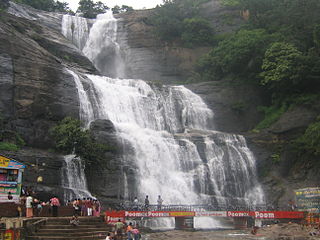
Kutralam Falls
Talking of nature, the waterfall is absolutely the ultimate shower. It is a combination of the shower and the bath at the well described above only many times amplified. I recall the thundering column of water that beat down upon my back at the famous Kutralam Falls which I visited many years ago. The water here comes down from a great height but the flow is slowed down by a crater midway making it safe for bathing. You would still be well advised to hold on to the railing when standing under the falls as you are being jostled by the milling crowd but the roaring water is guaranteed to render you oblivious to everything. Other thrills here include keeping your personal belongings safe from the many monkeys around.

Our scriptures prescribe the bath (snanam in sanskrit) as an essential daily ritual in itself. And no other ritual is possible without a bath first. Ritual or not, bathing in water that is flowing or pouring over your head (I don't care much for soaking in the bathtub) not only cleanses the body but invigorates the mind too. So I hope you enjoy every moment of this ritual as much as I do even if you are hurried in the morning. But let us be water wise and help conserve it too.

Image: https://upload.wikimedia.org/wikipedia/commons/thumb/f/f5/Courtallam.jpg/320px-Courtallam.jpg

Tuesday, February 16, 2016

The Television Trap

Television! Can you live without it? Of late, I have been toying with the idea of, gasp, cutting the cord and going completely online. You will no doubt say that I am not really giving up on watching TV. And you will be right, but I do want to make a serious effort to cut down. Ironically, the networks are making this easy.

The whole experience of watching TV has become very different over the years. Take the programming for instance. There are basically a few categories - mysteries, medical dramas, sitcoms and soaps. Sometimes it feels like the same show is playing over and over with a different cast. But that has not stopped me from watching them. I have realized that I am basically addicted and that I have to make a conscious effort to be very selective. There are hundreds of channels now, which means that we have loads of bad programs to sift through and a good one is the needle in this haystack.

The segment that is growing  fastest is perhaps the so called reality shows. It is just a cheap and lazy way to produce new shows. Mind you, these are not exactly real but productions of scripted reality complete with casting calls and all. Some of these can be interesting but mostly they translate to trash in my opinion. Unless one likes to watch the endless drama of the Kardashians or 'Real Housewives', reality shows have little to offer.

Not long ago, commercials used to be the main irritant when watching TV. But with newer technology, mercifully, we can avoid them easily. Nowadays, I hardly watch any program when it airs. I record it on the DVR and watch it later which enables me to fast forward through the commercials. Sports is perhaps the one exception to this. Somehow it becomes cold once the event is over and all you are interested then is to know how it ended. In sports, by and large, commercial breaks are dictated by the actual game so you tend not view them as intrusions. More accurately, you may say that the game is designed/modified to provide the necessary breaks. As Wodehouse said of football, 'They run a play and then stand around and talk about it'. The games are designed to allow for enough time outs and such so that the sponsors can get their messages across (and the networks can collect their money).

I think money has taken the fun out of watching cricket on TV entirely. With multiple cameras, and mikes on the ground, coverage has become very sophisticated over the years. I don't get to watch much cricket but when visiting India, I would try to take in a game occasionally. I was very disappointed recently trying to do that. The screen  had multiple frames (which expanded and contracted all the time) with commercials playing on the side even while the game was on. When a batsman got out, there was no instant replay but instant switch to advertising. I don't know how the fans are putting up with this.

Talking of money, the insane amount a spot costs during the Superbowl makes the commercials big production numbers in themselves. So much so, and I am not making this up, they command their own audience. You can actually watch just the commercials and skip the game altogether (Here's a link: How to watch just the superbowl commercials) many of them even before they officially air. It makes you wonder why companies pony up the big bucks to snag the spots during the game.

The other program that you have to watch live is of course the news. But news, especially on 24x7 news channels has become a sort of video game now (call it Spot the News, if you like). The screen is divided into many frames each telling its own story. With all of them vying for your attention, it is quite difficult to concentrate. Exhausting if you ask me. Whenever there is some breaking news (there is always some breaking news) the screen flashes 'Breaking news' along with a headline at such a rapid rate that you need to see it four or five times before you can read the whole thing. It is sometimes shown one line at a time making it extra challenging to put it all together. It calls for the use of, pardon the jargon, packet switching techniques. Below the banner, a video clip (beware - this may not always be the actual story) will be playing in a loop endlessly. One or two other frames with talking heads will be thrown in for good measure. A running display at the bottom showing other news items only adds to the general confusion. A few seconds of this, and my head usually starts spinning. I wonder if I can only gather the news subliminally!

From another angle, I think it is kind of hilarious. Just the other day, Bill Cosby was being arraigned in court to face charges. The news report showed him getting off the car and walk the few steps to the court house. As usual, this video clip was played in a continuous loop. I saw him get off the car and take the faltering steps almost stumbling at the curb while being supported by a couple of people and enter the court house, only to instantly reappear outside again getting off the car and so on endlessly. I tried to imagine that the scene was actually repeating in real time and that ultimately Cosby would eventually take a tumble!

Anyway, as I said, all of this has me looking at cancelling the cable service altogether and joining the increasing tribe of 'streamers', if I may use the term. I don't watch a lot of sports so I probably will not miss it. As for the news, I can definitely get it online. That will still leave me being a customer of the cable company for my internet service but I can at least decide what to watch and when, which is actually whatever, whenever! I think this may actually help me cut down on the time spent watching. And that will be a good thing. If I don't end up binge watching shows online, that is.

Saturday, January 2, 2016

A Roman Affair

The Superbowl is going to be fifty this season. For those who may not know, Superbowl is the ultimate event in the game of football (the American kind of course).  Let me clarify something right away. This is not really about the game. I do take in the odd game now and then and usually watch the Superbowl, but I am not really into it or know enough to write about the game. I was just amused to see that they changed from using Roman numerals to designate the event. It is going to be 'Superbowl 50'. Last year you will recall that it was Superbowl XLIX.

Why use Roman numerals? Their use seems to be merely ornamental. Other sports do not seem to bother with keeping track like this. Baseball has its 'World Series' (but with teams from just two or three countries participating!) but not 'World Series MMXV' or 'World Series CXI'. The basketball league, NBA, has just the 'Championship'. NFL (or is it NF50?) being the richest, perhaps has assumed the royal mantle and uses Roman numerals. After all, the royals have always used them - Richard III, Henry VIII, etc.

With the Olympics, despite their Greek origin, Roman numbering seems to be in vogue. Luckily we refer to the events using the year or the location rather than the actual number, e.g. the 1984 Olympics or the Los Angeles Olympics as opposed to the XXIII Olympics. And mercifully, the year is not MCMLXXXIV but just 1984.

It was quite alright when we were dealing with small numbers. But with the Superbowl which is an annual affair, it was bound to get somewhat tedious to keep using Roman numerals. I do wonder how fans would have liked it if the golden jubilee event was referred to simply as 'Superbowl L'. And imagine if the the scores too were shown using these numerals. That will certainly send the already frenetic fans into a tizzy with much teeth-gnashing and hair-pulling. Obviously, the NFL has thought the better of it and it will be 'Superbowl 50' this year. I can only hope that we will not have to deal with Superbowl LI' or any further silliness.

The Romans were generally a practical people. I wondered how they carried out the calculations needed to build those famous arches using the Roman notation. No serious arithmetic can be performed with them. Even deciphering what the numbers are is cumbersome. We have seen them used in movies when the copyright statement shown. Why? Apparently, they do not want you to know how old a film is. It takes some V seconds to read it, if you know what I mean and before you can read the MCM... etc., the frame changes.

According to what I could find, the Romans used a board somewhat similar to the abacus, to perform basic arithmetic. You can see some details of this in this article. The author of the article goes on to say that using the counting board is simpler than calculating using the modern numerals. An interesting viewpoint, though I was not convinced. I went so far as to try the counting board which I emulated on a spreadsheet. It worked well enough for simple additions and subtractions. It was quite tedious for multiplications and when it came to division, I just gave it up. I do not even want to know how fractions are handled.

Maybe I am overreacting. Perhaps I should use these numbers to write my next cheque? But I don't want my cheques bouncing. How about filling in any form? For instance,

Date of birth (MM/DD/CCYY)   VIII/XXIX/MCMLXVI
Height (cms)                                CLXXIII
Weight (kg)                                  LXVII

I am sure that will be much appreciated.

I am so used to the decimal system that I am probably biased. But it will be alright with me if we stopped using Roman numerals altogether. The only occasion where I will recommend that you use them is to count sheep when trying to get to sleep - i, ii, iii, iv, v, vi, and so on. You can imagine the numbers stamped on the sheep as they jump over the fence. The effort to keep up with the alphabet soup is sure to put you out.

Happy MMXVI, ahem, I mean, 2016!

Sunday, December 13, 2015

Lost and Found

As I got in the cab and told the driver where to go, I was surprised when he asked me whether I knew the way to my destination. The whole idea of taking a cab is to leave all the stress of driving and figuring out the best route to the driver. How does a cabbie not know his way around? Maybe he was testing me to see if I was new in town. Was he planning to run up a huge tab by taking me all around the place? Anyway, I was not familiar with the area I was visiting. When I said as much, the driver started calling his dispatcher for directions. I guess he really did not know the route.

Finding your way around in India armed just with the destination address is often an adventure. Street signs are conspicuous by their absence and the few that you find have notices stuck all over them. The houses have numbered and re-numbered a few times so the present one or the one you have may not stand out among all the different ones. In fact, many houses have 'Old No' and 'New No' signs. But all this is only good when you have arrived at the actual street. Normally, I depended on the taxi driver to take me at least to the locale. This driver, I assumed, was new to the city. I was sure that he would get us lost. I sat back and decided to enjoy the show so to speak.

In the US, I have got used to street signs that are prominent and the houses that are numbered in sequence from one end of the street to the other with odd numbers on one side and even numbers on the other. You do not have to contend with old and new numbers. In general, it is pretty easy to find your way around. If you got lost, you could stop at a gas station to ask for directions. But then, there are also places like the Los Angeles freeway system which is really intimidating to the uninitiated. With stacked three-level interchanges and winding ramps, it is a veritable concrete maze and can be a nightmare to navigate even for experienced drivers, let alone newcomers. I distinctly remember the time when the middle lane (yes, the middle lane) of the highway I was on suddenly deposited me in the thick of LA's Chinatown.

These days, GPS based navigation systems help us largely avoid getting lost. Back in the days (it seems I am reminiscing a lot nowadays - no doubt, a sign of aging!), one had to rely on maps. Reading maps - now, there's a skill that may be lost forever. I have sometimes seen people driving with a map folded to fit over the steering wheel and trying to figure out their way. A bit scary, that.

With a GPS, it seems impossible to lose one's way. But the thing is, you can be lost and never know it since the navigator constantly recomputes your route. The voice from the box keeps telling you, 'When legally possible, make a u-turn' and makes sure that you are still headed to the destination, never mind that you have already gone a mile past that left turn you were supposed to make. On the other hand, if it pounced on you with, 'You missed that turn, you moron. Are you even paying attention?', you would realize your mistake quickly. I think it is something to consider for the makers of these devices. They should mix it up with the way the instructions are delivered. Otherwise, the dulcet voice giving you directions in a monotonous fashion may end up putting you to sleep. Then you will surely be far worse than being lost. I wonder if the device will still tell you to make a u-turn then.

I am sure all of us have stories of occasions when we got lost on the road. But I once managed to sort of lose my way when travelling by train. It was several years ago when a friend and I were going by train from New Brunswick to Philadelphia, changing at Trenton. I was then to proceed to Washington DC. A mutual friend had dropped us off at the New Brunswick station. We had bought our tickets and boarded the train that just arrived. We were intently discussing something and were puzzled when the train conductor asked us where we were bound after checking our tickets.

'Gentlemen, this train ain't going to Trenton. It's going to Newark', he informed us in a grave tone, when we said, 'Trenton'. We were dumbfounded. How could we be on the wrong train? 'Tell you what', he continued, 'Get off at the next station, cross over to the other side and take the train going the other way'. We had been so lost in conversation that we got into the train going the wrong way! So we ended up getting off, as suggested, at the next station which was Metuchen, NJ. We diligently crossed to the opposite platform and waited for the train. A simple enough task to hop on the next one, you'd think. Well, not quite, as it turned out.

I am sure Metuchen is an admirable place, but while many trains passed Metuchen, only a few stopped there. At least, that was the case that day. We discovered that we had a rather long wait for the next one which meant that we would miss our connections. So we walked out  to see if we could take a taxi instead to a station where more trains stopped. We were pleasantly surprised to find that Metuchen station had quite a large population of taxis. There must have been over fifty of them waiting outside on that lazy Sunday afternoon. I thought maybe it was common for people to find themselves stranded in Metuchen.

Once we got into the taxi, we debated where we should go. We could go back to New Brunswick, but we felt going to Newark would enable us to catch an express. Unfortunately, we realized that we did not have enough cash to pay the fare to go that far. Neither of us had a credit card - I was a visitor and he a newly arrived graduate student. Besides, back then, I am not sure the cab driver could have processed a credit card even if we had one. I had some traveller's checks and had to ask the driver if he would take them. After a brief stunned pause, he interjected, 'Say what now?', with which he somehow managed to convey a mix of an incredulous 'You got to be kidding me' and a worried, 'Am I going to be stiffed by these two?'. It was definitely a first in his experience, I could tell. I have no doubt  that he regaled his bar companions that night with this story. Perhaps even now, he is relating it to his grandchildren, saying, 'You know kids, as a cab driver, you get to see a lot of stuff, but let me tell you...' or something like that.

So we had to settle on going back to New Brunswick. From there, we caught the next train that came by and missed our connection as expected. I had a sneaking suspicion that we could have caught the same train at Metuchen itself, but it would have been too embarrassing to take the cab back to Metuchen!

The sustained loud horn of a bus brought me back to the present with a jolt. My driver had finally stopped the car to ask for directions incurring the wrath of the bus driver behind us. I now saw that I had misjudged the guy. It seemed that he had actually managed to reach close to our destination, but finding the actual street address was proving to be elusive. The good thing was that there was no dearth of people to ask. Getting useful information from them was another matter. One helpful person asked, "Are you sure it is Raman Street and not Rajan Street?". "Yeah, I am not even sure of the street", I muttered under my breath to myself. Another worthy offered to hop into the cab and show us the way but could we please drop him off along the way?

We then asked a vendor who was pushing a cart full of tender coconuts. He shook his head and said,  'Raman Street? I don't think that's anywhere nearby'. He shouted across the street to various people, "Hey, do you know where Raman Street is?" all the while also asking us if we wanted coconut water, with a coconut in one hand and a menacing cleaver in the other, intent on making a sale. After a few minutes of this mid-street drama, with more players joining the cast, and some serious debate on which was the best way to get to Raman Street, someone who actually knew how to get there came around and we were eventually on our way.

Saturday, November 7, 2015

The Irrational Card

"To get your gas cylinder, you'll need a ration card", said Raj. Chandar was perplexed. The last time he checked they didn't sell gas cylinders at the ration shop. He had recently moved to Bombay with his wife and kid and needed to transfer the gas connection from Madras. Technically, he had surrendered the connection and would get a cylinder allotted on that basis. Gas connections were not easy to get but having a 'surrender voucher' was all it should take. So the mention of a ration card threw him for a loop.

"In Bombay", continued Raj, "They do things differently. You have to have a ration card to establish proof of residence". "OK, so I'll apply for one", Chandar said. Raj, with a look bordering on pity, said, "Oh, no, Chandar. It is not that simple. You are renting your flat. Your landlord must be willing to give you a 'no objection certificate'. Good luck getting that. And if you get it, it will still take a couple of months and a lot of persuasion at the rationing office, if you know what I mean, to get a ration card. Even then, you will likely get a temporary card". Most people endorsed this view. One even said that it required the perseverance of Bhagiratha (the legendary king, who through intense penance, had brought river Ganga down to the earth from heavens).

Thus discouraged, a moody Chandar went back home to his family. Their child was only about nine months old and often needed a bottle in the middle of the night. Heating up milk on a kerosene stove took time and made for some trying time as the baby would start crying. As a result, he and his wife were always a little sleep deprived and tended to be cranky. As he dreaded, the first words out of Aarathi's mouth were about the status of the gas connection. He had to break the news to her gently. She did not take it well. "Why don't you go down to the gas agency and try explaining to them?", she asked. Chandar told her what Raj had said. She seemed unconvinced, but said nothing more.

Chandar did some research and found out it was indeed quite difficult to get a ration card for the first time, but slightly easier if you had a previous card. He learned also that his wife's name was still on her family's ration card back in Madras. He arranged for her name to be deleted from that card and a 'Deletion Certificate' sent over to him by express mail. When he saw the certificate, however, his heart sank. Despite the officious sounding name, it was hand-written (in English, luckily) on a quarter sheet that had been torn off a full-sized sheet. The only official looking thing on it was the rubber stamp, but that was in Tamil. It looked fake, but such an amateurish fake that it would be taken as genuine, he reasoned and hoped.

He was now ready to tackle the ration card. When he mentioned this to Raj, the all-knowing Raj advised him to engage one of the touts that usually hang around outside the rationing office to get the card. "It will cost you some money, but it saves you a lot of hassle. Don't even bother going in. You just can't deal with the office staff. The tout will grease the works and get you the card. But don't pay more than Rs. 75". However, another coworker told Chandar that he should just go and talk to the ARO or the Assistant Rationing Officer directly. "Go and speak to him in English. Sometimes that works as he may feel flattered", he said. Raj of course scoffed at the suggestion. "In fact", he warned, "Speaking in English may just put him off" and strongly recommended the tout.

Chandar took the next day off and went to the rationing office. As he got off the auto rickshaw, he was shocked to see a huge crowd. But he was relieved to note that it was actually a political rally that was passing by. Elections were round the corner after the recent assassination of Indira Gandhi. The Congress party was clearly intent on capitalizing on the tragedy with posters proclaiming, 'Boond boond se desh ki raksha'.

The rationing office was an old one-storey building that stood out among the many newer ones around it. As mentioned by Raj, there was a milling crowd outside with a lot of people talking to the so-called touts. Chandar hesitated a little but decided to go inside and try the regular channels. He pushed through the crowd brushing aside the many offers to get him a card the same day and entered the compound. He was surprised to find a kind of urban oasis inside with many trees. The air was cool and the atmosphere peaceful, quite a contrast to the crowd and chaos outside. It was apparently a slow day at the rationing office. The building had tiled roofing and there was a series of windows along a long veranda. He approached the one that had the sign, "Hemant Chavan, ARO". The sign was in Marathi as were all the signs there. Would the staff entertain English here, he wondered. He approached the window with trepidation.

"Hi. I want to apply for a ration card", he said the ARO. To his relief, the ARO replied in English and asked him a few questions. After listening to Chandar's story, he asked if he had a ration card in his name anywhere or if his name was on someone's card. Chandar replied in the negative to both. "Please write a letter certifying to that and bring it to me", he said finally. Chandar quickly did as he was told. The ARO took the letter and the deletion certificate. He wrote something on the margin and then handed them back to him along with an application form. He asked Chandar to fill up the form and take it to Counter 5.

Chandar was elated as getting the form, surely, was a major breakthrough. But the form was in Marathi. While he could read the script, thanks to having learned Sanskrit, and could survive in Bombay with his broken Hindi, Marathi was a different story. As he was looking the form over from side to side trying to figure out words like  'aayu' and 'mulga', he saw the clerk at Counter 5 beckon to him. He had guessed Chandar's plight and to his surprise, offered to fill out the form for him. Chandar was relieved and gave the answers to the questions in Hindi. The clerk smiled as he took down the address. "My cousin too lives in the same building", he said to Chandar. That seemed to seal the deal. Chandar could come back in a week and pick up the card subject to verification. As he took the receipt and walked out, Chandar could not believe what had happened. Perhaps these government workers do not deserve the bad reputation they have, he thought.

He decided to go the gas agency and try his luck there too. Even though he did not have the ration card, the receipt might do the trick. At the gas agency, the moment he produced the Surrender Voucher from Madras, the sales clerk flipped it over and asked, "What's your address?" and wrote it down. He was then asked to to pay the deposit and just like that, he got his new gas connection! This was unbelievable. There was absolutely no demand for the ration card. The clerk then proceeded to ask Chandar if he wanted to apply for a second cylinder and Chandar had to grip the desk to keep from falling. Of course he wanted to apply and he did.

After all the formalities were through, Chandar asked when the gas cylinder would be delivered. The clerk told him that the delivery staff were on strike and he could not say. "Ah, my luck has at last run out", thought Chandar, but luck as still on his side. The clerk then added, "If you like, you can just go to the warehouse and pick it up yourself".

Thus it was that Chandar arrived home by an auto rickshaw with the gas cylinder. He was eager to surprise Aarathi and managed to carry the cylinder by himself up four flights of stairs (the auto driver refused to help). This was real hard work. He had to pause at every landing to catch his breath. He felt a wave of sympathy for the striking delivery boys and made a note to himself to tip them well the next time they delivered.

At last, he reached his door and let out a weary but triumphant sigh. He felt quite the same way a caveman might have felt when dragging home a kill. Aarathi squealed with delight on seeing the red cylinder and asked him how he had managed to get it. When he explained all that had happened, she said, "So you're telling me that you could have done this two weeks ago. And all this time I have been struggling", deflating his smug satisfaction in an instant. It was not quite the hero's welcome he had hoped for. But she added softly, "Well, you carried that thing all the way up here. Why don't you rest up? I'll make you a nice cup of chai  on the gas stove".

The next day at work, Raj all but fainted when he heard the story. And Chandar became a legend of sorts for obtaining the ration card without resorting to touts.

Saturday, October 3, 2015

Just In Time

"Never put off till tomorrow what you can do the day after tomorrow.” – Mark Twain

When I started this blog, I had intended to write about one post per month. More than that would tax my puny creativity and less might mean people would lose interest. After two and a half years, I can say that I have more or less kept to this plan. But every now and then a month slips by without a post. Since I do not have a real deadline, I seem to be giving in to laziness. So I thought that I would try and make the best of it by writing about doing things in time.

We are loathe to do anything before it is necessary to do it. I am reminded of my college days when, if an assignment was due at 8 in the morning, we would do it the night before. But if it was due at 5 in the evening, we would do it during the breaks on the same day. I remember one occasion when the professor announced a paper that was due at the end of the term some 12 weeks away. One master planner among us wanted to know if it was due at 8 am or 5 pm! You knew when he was going to write the paper.

Jokes apart, I feel that this is actually a pretty smart way to plan and spend your time. Do what you must when you must, no earlier than that. By all means do things in advance, if you like; only make sure you are not obsessed with deadlines. Besides, being early is not always a good thing. The early bird may get the worm, but that means that the worm that decides to sleep in survives! Arriving early to a meeting only makes you wait for others to show up. In this sense, 'Punctuality is the thief of time', as Oscar Wilde put it. Why do something before it is necessary to do it?  I mean, why rush to a red light only to stop? Let us do things just in time.

Just-in-Time or JIT is a principle that has been successfully employed by manufacturing companies to improve overall productivity and quality and reduce costs for several decades now. We all remember how the Japanese car  makers took over the US market using JIT manufacturing. The essence of this approach is to order just the amount of parts or materials needed exactly when needed. Holding on to parts not needed is a huge cost and is to be avoided. Inventory is evil.I am simplifying of course, but you get the idea.

This principle also spurs the aggressive marketing campaigns that paradoxically urge us to buy more. Any finished product must be shipped out to consumers without delay for holding on to it is way costlier than just holding the raw materials. So we are exhorted to buy large quantities of everything so that we can ‘save’ money. Yes, if you spend more money, amazingly, you are saving more. It is true that if you bought a 2-litre bottle of shampoo you are paying less per litre than if you bought a 200-ml bottle. But do you really need that much? Do you want to spend that much? Do you have the space to store all that? And what are you going to do when the company comes out with an improved version that you very much want?

One thing is certain - we save money for the company by pulling their goods out of factories into our homes and garages. The manufacturer does everything to reduce stocks (since it translates into cost) while keeping the factories humming. Meanwhile, the consumer unwittingly carries huge stockpile of things essential and not so essential. People fill their homes and even their garages with all sorts of things they buy in bulk because, you know, it's cheaper that way. And it is even likely that he is financing that through credit card debt. I am sure you appreciate the irony here!

Shouldn't we be buying things just in time, when we need them? I think we should all take a leaf out of the company's book and practice JIT too. That way we can employ our resources more efficiently and make our money productive as it will not be tied up in inventory. We can try out different products by buying in small quantities, we can save space, etc. I am sure you can add more to the pros of this approach. And I do not see any cons.

I believe this will have really far-reaching consequences if applied on a large scale, going back in the supply chain all the way to Mother Earth herself. Keep the tree intact instead of storing it in the form of paper, for example. We can give Mother Earth time to renew her stock! I know, I know – it is all too radical and Utopian. Besides, won’t the economy tank if consumer spending decreases? Well, I am no economist (and with that disclaimer, I can say almost anything about the economy now). Perhaps in the short run there will be an impact, but I think it will lead us towards a more sustainable way of living in the long run.  

There, I got this done just in time for the weekend! Please read this now so you can go about getting your weekend chores completed in time too.